Prices, subsidies and tariffs change from time to time. Call us or fill the form for the latest figures.
Solar street lights look simple: a panel, a battery, an LED and a pole. In practice, most failures in societies and gram panchayats come from undersized batteries, cheap controllers and lights mounted too high for their wattage. This guide covers how to size each part, what to write in the purchase order, and what to check at handover.
What is a solar street light, exactly?
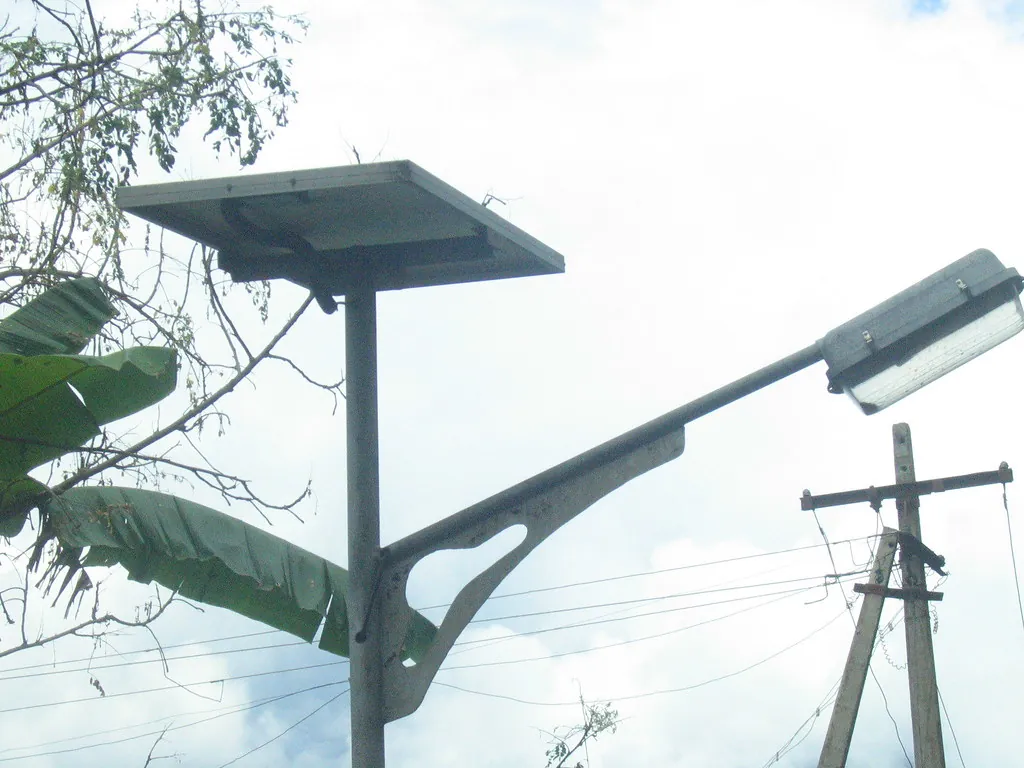
A solar street light is a standalone lighting unit that charges a battery from a solar panel during the day and runs an LED from that battery through the night, with no grid connection or wiring between poles. Because each pole is independent, a single failure does not take down the whole road, and there is no electricity bill.
There are three common designs:
- All-in-one (integrated): panel, battery, LED and controller in one housing on the pole. Quick to fit, harder to tamper with.
- Semi-integrated: LED and battery together, panel mounted separately so it can be tilted properly.
- Split type: panel on top, battery in a box on the pole or underground, separate luminaire. Suited to higher wattages and wider roads.
How do I size the LED for my road?
Start with mounting height and road width, not with wattage. A brighter LED on a short pole only creates glare and hot spots.
| Application | Pole height | Pole spacing | LED wattage | Lumens (approx.) |
|---|---|---|---|---|
| Society internal lane, park path | 4–5 m | 15–20 m | 9–12 W | 1,400–1,900 |
| Village lane, colony road | 5–6 m | 20–25 m | 12–20 W | 1,900–3,200 |
| Main village road, campus road | 6–7 m | 25–30 m | 20–30 W | 3,200–4,800 |
| Approach road, parking, boundary | 7–9 m | 30–35 m | 30–60 W | 4,800–9,000 |
Ask for LED efficacy of at least 150 lumens per watt at system level, colour temperature of 5,000 to 6,500 K for roads (or 3,000 to 4,000 K for parks and residential frontage), and a Type II or Type III road optic rather than a round “bulb” pattern.
How do I size the battery and panel?
Use a four-step calculation. Here is a worked example for a 12 W LED.
- Night energy: with a dimming profile of 100 percent for 4 hours after dusk, 50 percent for 6 hours and 100 percent for 2 hours before dawn, energy = 12 × 4 + 6 × 6 + 12 × 2 = 108 Wh per night.
- Autonomy: for 2 nights without sun, storage needed = 108 × 2 = 216 Wh.
- Battery size: LiFePO4 can use about 80 to 90 percent depth of discharge, so 216 ÷ 0.85 ≈ 254 Wh. At 12.8 V, that is about 20 Ah. Choose 24 Ah for ageing margin.
- Panel size: to recharge one night’s energy in a day with 4.5 peak sun hours and 70 percent system efficiency, 108 ÷ (4.5 × 0.7) ≈ 34 Wp. Choose 40 to 50 Wp so the battery also recovers after a cloudy spell.
The same method gives roughly these configurations:
| LED | Panel | LiFePO4 battery (12.8 V) | Autonomy |
|---|---|---|---|
| 9 W | 30–40 Wp | 12–18 Ah | 2 nights |
| 12 W | 40–50 Wp | 20–24 Ah | 2 nights |
| 20 W | 75 Wp | 30–40 Ah | 2–3 nights |
| 30 W | 100–120 Wp | 50–60 Ah | 2–3 nights |
See our lithium vs lead-acid battery guide and the glossary entries for LFP battery, depth of discharge and peak sun hours.
Which IP rating and build quality should I specify?
- Luminaire: IP65 minimum, IP66 for coastal and heavy-rain districts. IK08 or better impact rating where vandalism is a risk.
- Battery enclosure: IP65 or better, ventilated against heat. In Rajasthan, Vidarbha or Bundelkhand summers, batteries in black boxes can cross 60°C, which cuts life sharply.
- Controller: MPPT charge controller (better than PWM, especially on cloudy days), dusk-to-dawn sensing, programmable dimming, low-voltage cut-off and reverse polarity protection. Read about MPPT.
- Panel: monocrystalline, facing south at roughly your latitude angle (about 25° in Varanasi), never shaded by trees or buildings.
- Pole: hot-dip galvanised, with a concrete foundation designed for local wind speed. Anti-theft fasteners for battery and panel.
What should a society or panchayat put in the tender?
- LED wattage, lumen output and efficacy, CCT and optic type.
- Panel Wp, technology and tilt; battery chemistry, voltage, Ah and usable Wh.
- Autonomy days and dimming profile in writing.
- IP and IK ratings with test reports from an NABL-accredited lab, and BIS registration for components where it applies.
- Warranty: at least 5 years on the complete system including battery, and 25-year performance warranty on the panel.
- Annual maintenance terms, response time for faults and a pole-wise asset list with GPS location.
Many panchayats fund street lighting through Finance Commission grants or MLA/MP local area funds. Rules differ by state and block, so check with your block development office before finalising quantities.
What does a solar street light cost?
| Type | Indicative price per pole, installed (2026) |
|---|---|
| 9–12 W all-in-one, 4–5 m pole | ₹14,000–22,000 |
| 15–20 W semi-integrated, 6 m pole | ₹22,000–32,000 |
| 30–40 W split type, 7–8 m pole | ₹35,000–55,000 |
Prices and subsidies change often, so call us or fill the form for the latest figures. Pole and foundation are often 30 to 40 percent of the cost, so reusing existing poles where possible saves money.
How do I maintain solar street lights?
- Wipe panels every 1 to 2 months in dry, dusty seasons and after Holi or harvest-season dust. See our panel cleaning guide.
- Trim tree branches before monsoon so panels stay unshaded.
- Check that lights switch on at dusk; a light burning in daytime means a faulty sensor.
- Log nightly run hours where the controller allows; a falling figure is an early warning of a tired battery.
- Match LED wattage to pole height and road width first.
- Battery Wh = night energy × autonomy days ÷ usable depth of discharge.
- Specify LiFePO4, MPPT, IP65+ and a 5-year full-system warranty.
- Two to three nights of autonomy suits most Indian districts.
- A pole-wise asset register and AMC terms prevent the “dead lights after two years” problem.
Planning street lighting for a society, campus or gram panchayat? Send us the road length, width and existing pole details, and we will prepare a pole-wise design and specification. Get a free quote from SolarEMS.
Send your electricity bill or a roof photo on WhatsApp and we will suggest the right system and price.
Frequently asked questions
What size battery does a solar street light need?
Size the battery for one night's energy multiplied by the autonomy days, divided by usable depth of discharge. A 12 W LED with dimming uses about 100 Wh a night, so for two days of autonomy a 12.8 V LiFePO4 battery of 18 to 24 Ah is typical.
How many days of autonomy should a solar street light have?
Two to three days of autonomy suits most of India. In the Northeast, hill areas and coastal belts with long monsoon spells, specify three days, or accept automatic dimming on continuous cloudy days.
Which IP rating is needed for solar street lights?
The luminaire should be at least IP65 so dust and driving rain cannot enter. For all-in-one lights where the battery sits inside the housing, IP65 or IP66 for the whole unit is a sensible minimum, with the battery protected from direct heat.
Are all-in-one solar street lights better than separate panel and battery?
All-in-one lights are quicker to install and harder to steal from, and suit internal roads and colonies up to about 30 W. For wider roads, higher poles or high-lux needs, a semi-integrated or split design with a separately tilted panel performs better.
How long do solar street lights last?
Panels last 20 to 25 years, LED fittings 8 to 10 years, and LiFePO4 batteries typically 5 to 8 years depending on heat and cycling. Lead-acid batteries often need replacing in 2 to 3 years, so most new tenders specify lithium iron phosphate.

Written and reviewed by our solar design & energy specialists. Figures are indicative as of November 2026 - always confirm current rules with the national portal or your DISCOM. About us
#autonomy#housing society#LiFePO4#panchayat#solar street light


